Legacy PFAS contamination at Salzburg Airport: Phase 2 of remediation begins
PFAS legacy contamination remediation enters phase 2 / Groundwater treatment plant from phase 1 continues operating in parallel / Amendment to the Landfill Ordinance still pending / Airport had to establish an interim storage facility for contaminated soil / Team of experts develops the best remediation solution for people and the environment
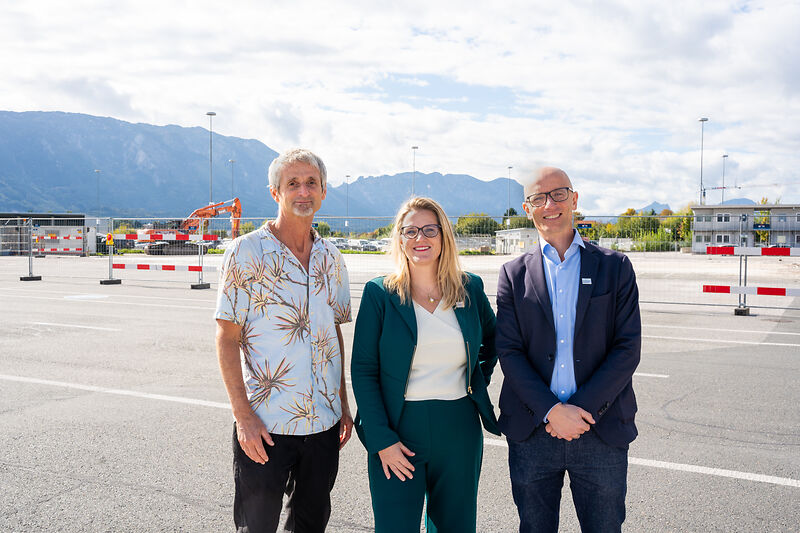
As part of a special federal monitoring programme, elevated PFAS concentrations were detected in the groundwater downstream of the airport in 2018. PFAS are also referred to as “forever chemicals” because they hardly break down in nature over decades. The contamination stems from the historical—but officially authorised—use of PFAS-containing firefighting foams during firefighting exercises since the 1960s. “With remediation phase 2, as Austria’s first major publicly known PFAS case, we are taking a pioneering role in the remediation of such legacy contamination. Through no fault of its own, the airport has found itself in the current legacy contamination remediation situation, but from the outset it has publicly accepted responsibility for the matter and provided comprehensive information,” said the airport’s authorised signatory, Dr. Verena Mitgutsch, who is also the overall project manager for the remediation of PFAS legacy contamination at Salzburg Airport.
Both the firefighting exercises and the foam used complied at all times with the state of the art at the time and were legally compliant. The use of the foams concerned was stopped immediately when the groundwater contamination became known and its cause was identified—firefighting exercises using PFAS-containing foam are no longer conducted on the airport grounds, and PFAS-free firefighting foam was introduced as one of the first measures. “We now want to implement the planned remediation project, but three prerequisites must be met. Timely approval by the competent authority, funding from the Contaminated Sites Remediation Fund and, finally, very importantly—the rapid creation of the necessary legal framework for the orderly disposal of the contaminated excavated material. I hope that we can now make swift progress in the process, and we would like to thank everyone involved—above all the people of Salzburg—for their patience,” Mitgutsch continued.
Legacy contamination remediation project begins
Based on comprehensive sampling, the airport has been preparing a large-scale legacy contamination remediation project since 2022, which represents pioneering work in PFAS legacy contamination remediation in Austria. The project was developed in close coordination with the Environment Agency Austria, the authorities and an external team of experts working for the airport. The causes and extent of the contamination were investigated. It must be made clear: the groundwater is affected—not the public drinking water supply!
Environmental monitoring by the Province of Salzburg has identified no acute health risk to the population. Nevertheless, as a precaution, people are advised not to use the affected groundwater as drinking water or to consume fish from the affected bodies of water.
Phase 1 – Groundwater treatment plant
The first remediation phase was launched in 2023 on the basis of these initial findings and valid survey data. PFAS-contaminated groundwater is extracted through seven wells, after which the groundwater is treated using gravel and activated carbon filter systems. Following this treatment process, the treated groundwater is returned to the groundwater body through infiltration systems. The entire process is subject to close monitoring and has already been adjusted several times to ensure optimal treatment results during continuous operation.
Phase 2
Initial situation and concept
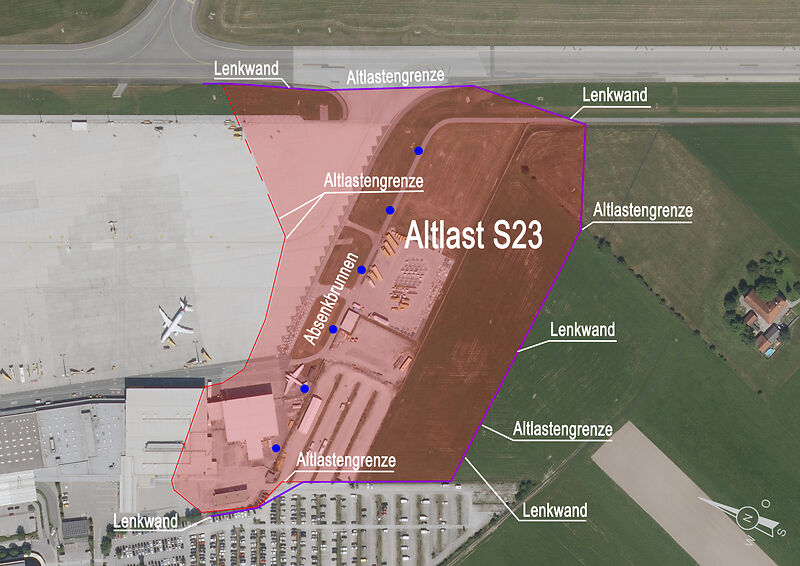
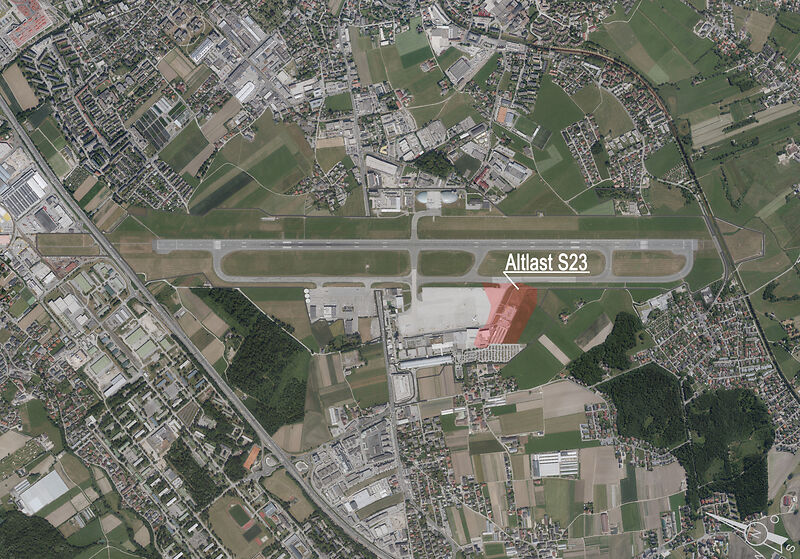
Remediation phase 2, submitted in April 2026 and designed by GWU Geologie Wasser Umwelt GmbH, builds on the findings from phase 1 and an expert study of alternative options. Further soil and groundwater investigations identified around 50,000 m³ of PFAS-contaminated soil and a contaminant plume approximately 3.5 kilometres long in the groundwater. These additional soil investigations also resulted in an extension of the originally designated contaminated site (see the Contaminated Sites GIS Register). The airport established the technical delineation of the contaminated site, as now defined, in autumn 2025; official publication under the Contaminated Sites Ordinance took place in September 2026 in the Contaminated Sites GIS Register. “Now that the technical delineation of the area and the associated remediation requirements are known, an estimate of the project’s total costs can also be made. Remediation of the PFAS legacy contamination will cost around €50 million, with the airport having applied for funding of up to €30 million from the Contaminated Sites Remediation Fund. The airport must itself bear the remaining amounts, which are nevertheless substantial,” said the airport’s authorised signatory.
Interim storage as a temporary solution / lack of a disposal route
One of the biggest obstacles to the orderly disposal of PFAS-contaminated excavated soil remains the absence of the amendment to the Landfill Ordinance, which is intended to establish binding limits for PFAS-containing soil. To avoid jeopardising major projects such as the ongoing terminal renewal, which also generates small quantities of PFAS-contaminated excavated material, the airport has established its own interim storage facility for PFAS-contaminated soil. The airport appeals to the Federal Government and all relevant stakeholders to swiftly create the necessary legal framework for a secure disposal route.
Schedule and sequence of construction work
Phase 2 is to be implemented in several stages over the years 2027 to 2030. The main construction work will take place during the summer months (April to October) of 2028 and 2029. In 2028, the extraction wells for hydraulic containment and the deflection wall will be constructed; in 2029, this will be followed by the surface sealing, including infiltration systems, and the completion of the new groundwater treatment plant and infiltration systems.
“The deflection wall, surface sealing and hydraulic containment together form the core of PFAS remediation phase 2. This includes drilling along the planned deflection wall route and securing and relocating existing utility lines and installations. Following an in-depth assessment conducted jointly with the Environment Agency Austria, this combination of measures is the best available solution for containing the legacy contamination in the long term. Our schedule is therefore set: we will begin preliminary investigations in summer 2027, the construction measures will take place in 2028 and 2029, and in 2030 we will complete phase 2 of the PFAS legacy contamination remediation,” said the airport’s technical project manager for legacy contamination remediation, Mag. Markus Einberger.
From 2030, the new installations of the groundwater treatment plant will be tested and optimised. The immediate measures established during remediation phase 1 will remain in operation until the new systems are fully commissioned, ensuring uninterrupted protection of the groundwater.
Additional information from preliminary investigations, monitoring or new scientific findings may necessitate changes to individual remediation measures. “Adherence to the schedule for phase 2 is subject to the necessary approvals being granted as planned and a disposal route being found for the contaminated material. There is no alternative to the missing revised Landfill Ordinance for PFAS-contaminated soil arising throughout Austria, and this should be addressed immediately,” said Mitgutsch.
Technical containment measures below ground
The core of phase 2 is a comprehensive subsurface containment system. A U-shaped, 20- to 25-metre-deep thin diaphragm wall made of impermeable concrete is intended to enclose the contaminated site on its southern, western and eastern sides and divert uncontaminated groundwater laterally around the contaminated soil area. Within this enclosure, six pairs of wells will be constructed to extract contaminated groundwater at a total rate of up to 15 litres per second; this water will be pre-treated and treated in a newly designed groundwater treatment plant.
The plant has been technically modified and appropriately sized based on the experience gained in phase 1, and adapted to actual operating conditions. Coordinated stages for iron removal, manganese removal, disinfection and subsequent activated carbon filtration are installed in the plant. This is intended to ensure that the drinking water limit of 0.1 micrograms per litre for the sum of PFAS 20 is met in the pre-treated groundwater. The treated water will be returned to the subsurface through specially dimensioned infiltration trenches southeast of the contaminated site.
Surface sealing and drainage concept
In parallel, all previously unsealed areas of the contaminated site, covering approximately 56,000 m², will be secured with an engineered surface seal. After the uppermost PFAS-contaminated soil layers have been removed, a multilayer structure will be installed, comprising, among other components, a high-density polyethylene protective membrane (HDPE), protective layers and drainage layers.
This sealing significantly reduces the entry of precipitation into the contaminated subsurface, thereby preventing further release of contaminants into the groundwater, and allows surface water to be collected in a controlled manner through a drainage system and directed to infiltration systems outside the deflection wall. Existing infiltration systems west of Hangar 2 and Terminal 2 will be decommissioned and replaced elsewhere by new systems with an upstream water protection facility.
Groundwater modelling and protection of existing abstractions
The planning is based on detailed groundwater modelling, which shows that groundwater in the area of the contaminated site can in future be fully contained and that no new PFAS inputs into the groundwater will occur. According to the expert assessment, effects on neighbouring groundwater abstractions are limited to groundwater level fluctuations of a few centimetres and are considered harmless. The airport’s own service water wells outside the remediation area will remain in operation. Four wells currently used for hydraulic containment will be decommissioned in an orderly manner once the new wells have been commissioned. The hydraulic containment function will transfer seamlessly to the new wells constructed within the deflection wall—the groundwater treatment plant itself will therefore remain in place permanently, as already established in phase 1, with technical improvements.
Monitoring and target values for PFAS in groundwater
Comprehensive monitoring will be established to verify the effectiveness of the measures. It will include a number of existing and new groundwater monitoring points upstream and downstream of the contaminated site, continuous recording of groundwater levels and regular chemical analyses focusing on determining PFAS concentrations in the groundwater. In the medium term, PFAS-20 concentrations of less than 0.1 micrograms per litre are to be achieved immediately downstream of the contaminated site. In the long term, a reduction in PFAS concentrations in the groundwater downstream is expected.
Noise impacts during construction
VATTER & Partner ZT-GmbH has prepared an acoustic assessment for the construction period of phase 2, during which work will take place on working days from 7 a.m. to 7 p.m. Based on the plans submitted for approval, existing airport measurement data, SAGIS noise maps and relevant ÖAL guidelines, the emissions of the main construction equipment were calculated—including a leader rig (a heavy machine used in specialist civil engineering that can drive piles, sheet piles or drilling augers into the ground with high precision) for constructing the thin diaphragm wall, compaction equipment, truck traffic and other construction machinery. The assessment is based on a total of 38 noise receptor points, primarily windows and outdoor areas of surrounding residential properties.
The calculations show that during the construction of the deflection wall and surface sealing, levels of 65 dB(A) may temporarily be exceeded at 20 of these receptor points. An individual acoustic and noise-related medical assessment will be conducted at these locations; at the remaining points, the expert classifies the construction noise as tolerable. Exceedances of 70 dB(A) will be limited to a maximum of two working days (these will be announced on the airport’s website), and exceedances of 65 dB(A) to a maximum of 19 out of approximately 130 noise-intensive construction days in total. On many days, the levels will be below the planning guideline values or below the existing ambient noise levels, which are already dominated by air traffic.
Vibrations and structural protection
A further expert report was prepared by tappauf.consultants gmbh. This addresses the expected vibrations and secondary airborne noise. The assessment covered the construction work for the thin diaphragm wall, the drawdown wells, the groundwater treatment plant, the surface sealing with ground improvement and impact compaction, and the new infiltration systems. The neighbouring buildings in the study area predominantly fall within area categories 2 and 3 under ÖNORM S 9012 and are considered to have normal to increased sensitivity under ÖNORM S 9020. The nearest buildings are approximately 100 metres from the thin diaphragm wall works and approximately 120 metres from the impact compaction works. Measurements from comparable projects and a test area from July 2023 were used to derive maximum vibration velocities of approximately 0.6 millimetres per second at the foundations of the nearest buildings. These values are well below both the relevant guideline values for building protection and the guideline values for protecting human well-being under ÖNORM S 9012. Secondary airborne noise is of lesser significance than direct construction site noise. Construction vibrations are also not relevant to neighbouring residents because of their short effective distances and the distances to the buildings. Vibrations caused by heavy construction traffic are expected to remain below the threshold of perception; as a precaution, the condition of buildings within the area of influence up to 150 metres will be documented for evidentiary purposes, and exposed properties will be remotely monitored.
When half of the relevant limit values is reached, those responsible for the construction site will be alerted and the construction methods adjusted if necessary. No relevant vibration or secondary noise impacts are expected during operation.
Information for neighbouring residents, complaints management and worker protection
Salzburg Airport attaches great importance to protecting neighbouring residents and providing transparent information. Since 2018, the airport has been working in close coordination with the Environment Agency Austria, provincial authorities and external specialist consultancies, and regularly informs the neighbourhood through mailings and its website about the causes, extent and progress of the remediation. As early as 2019, the airport publicly reported on the PFAS contamination for the first time—including in its annual report; in March 2022, in addition to a press conference, a dedicated information event was held for the general public involving an interdisciplinary team of experts. Since then, medical specialist Prof. Hans-Peter Hutter of the Medical University of Vienna, among others, has supported the project on environmental medicine issues. “We assessed the findings of the technical reports on noise and vibrations affecting the surrounding neighbourhood from an environmental medicine perspective and developed comprehensive protective measures to reduce the impacts of the construction work on the affected neighbouring residents,” said Prof. Hans-Peter Hutter.
Comprehensive expert reports on noise, vibrations and secondary noise have been prepared for the upcoming remediation phase 2. On this basis, the airport is restricting noise-intensive work to working days from 7 a.m. to 7 p.m. (with a lunch break); no work will take place at night.
Since the immediate measures began, publicly accessible information, particularly the FAQs, has been continuously expanded, updated to reflect the current state of information and, following the identification of further contaminated areas, supplemented with a link to the Contaminated Sites GIS.
A central element of phase 2 is structured information and complaints management. A central contact point will be established at the airport for questions, concerns and complaints, drawing on information from the specialist departments and external experts. During the construction phase, neighbouring residents can contact the airport directly at altlastensanierung@salzburg-aiport.at; enquiries will be answered as quickly as possible (further contact options will be announced). In parallel, the airport will promptly provide up-to-date information on its website. The aim is to minimise any adverse effects of the remediation work on the neighbourhood as far as possible while ensuring a high degree of transparency and traceability.
2nd press conference and 2nd public event
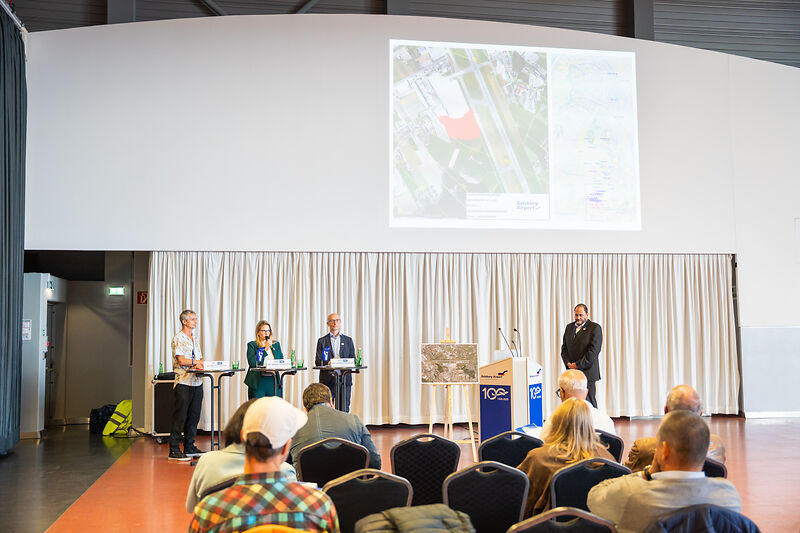
On 12 October 2026, the airport provided the public with detailed information about the current status and next steps of phase 2 of the legacy contamination remediation at a press conference and a public event for interested and affected parties at Amadeus Terminal 2. On the same day, a press conference was held at 10:30 a.m. for all interested journalists.